Si Hmad Derhem
A Legacy of Commitment
A native of Taloust, a village in the Aït-Baâmrane region of the Anti-Atlas Mountains, Si Hmad Derhem made his fortune in commerce early in his life.
By the end of the 1930s, his enterprise and commitment had contributed significantly to the growth of his native region. The founders of Dar Si Hmad took inspiration from his moral principles as a gifted, wise, and self-taught individual.
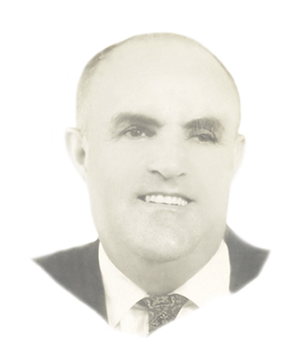
Biography
He facilitated access to and diffusion of knowledge. With the participation of the people of Aït-Baâmrane and the Sahara, he developed a system of communal aid to improve the living conditions of the region.
Si Hmad Derhem’s heirs first founded The Derhem Foundation, Dar Si Hmad’s major trust-fund, in order to promote his values and pass on his legacy.
Si Hmad was born in 1909. His family descended from the Zaouïa of Abdellah Ben Sassi in the Haouz of Marrakech, who originally came to Aït-Baâmrane to combat the Spanish incursions in the 1500s. Si Hmad received a traditional Islamic education and acquired the title of Si-Hmad, the “Si” prefix signifying he learned the Qu’ran by heart, a distinction given to literate individuals to this day.
At 16, Si Hmad migrated to the Spanish occupied region of Tangier-Tetouan in northern Morocco. He worked for several years and amassed a considerable amount of money which he brought back with him, sewn into his clothes, to his native Aït-Baâmrane. In 1932, Si-Hmad relocated to Terfaya to start a business. Terfaya was the testing ground for the Aeropostale Company, which later became Air France, and Saint Exupery and Mermoz were among the pioneering pilots.
The Sahara fell under Spanish occupation in 1934. With Franco’s victory in 1939 and the anti-Franco movement actively attempting to destabilize the regime, security became a major concern. Military forces based in Spanish West Africa were preoccupied with surveillance of the Canary Islands, and the colonial regime encouraged local families established in commerce to create a company to meet the food, clothing, and other needs of the region.
Together, the Bouaida, Derhem, Aregrag, and Rezma families formed La Compañia. La Compañia became a symbol of economic achievement and success in a social system dominated by colonialism. Its directors were not interested in pure economic gain only; they used their success to finance the Armée de Libération and played key roles in the clandestine anti-colonization movement in Morocco.
By 1958, The Armée de Libération was a growing force with mass support from the Atlantic Sahara and Mauritania. Under the Plan Ecouvillon, France and Spain mobilized together to destroy the Armée de Libération, which had sought refuge in the liberated Northern Aït Baâmrane Moroccan territory and in Goulimine, where they kept their headquarters.
The remaining Armée de Libération suspects were sent to Fuerteventura prisons, and Spanish public decrees rendered La Compañia insolvent. While Si Hmad was safe in newly independent Morocco, his brother Faïdul was taken prisoner along with other known members of the Saharaoui resistance.
After Operation Ecouvillon and the defeat of the Armée de Libération in 1958, Si Hmad settled in Casablanca with his family. A few years later, in 1963, Si-Hmad ran for election in the region of Goulimine and Aït-Baamrane, but was fraudulently defeated as campaigns targeting political enemies of the state were common. To protect himself, Si-Hmad took refuge first in Algeria and subsequently in Spain. He did not return to Morocco until 1967.
Once the Spanish consented to Si Hmad’s return to the Sahara, he began to advocate for the restitution of the Sahara and started working in trade once again. Si Hmad and other partners acquired Atlas Sahara, a distribution company for petroleum products. Si Hmad managed Atlas Sahara until his untimely death in July 1982.